Independent crypto payments guide for Kenya – updated 24 August 2026
CHEXX Crypto Payments: Coins and Networks
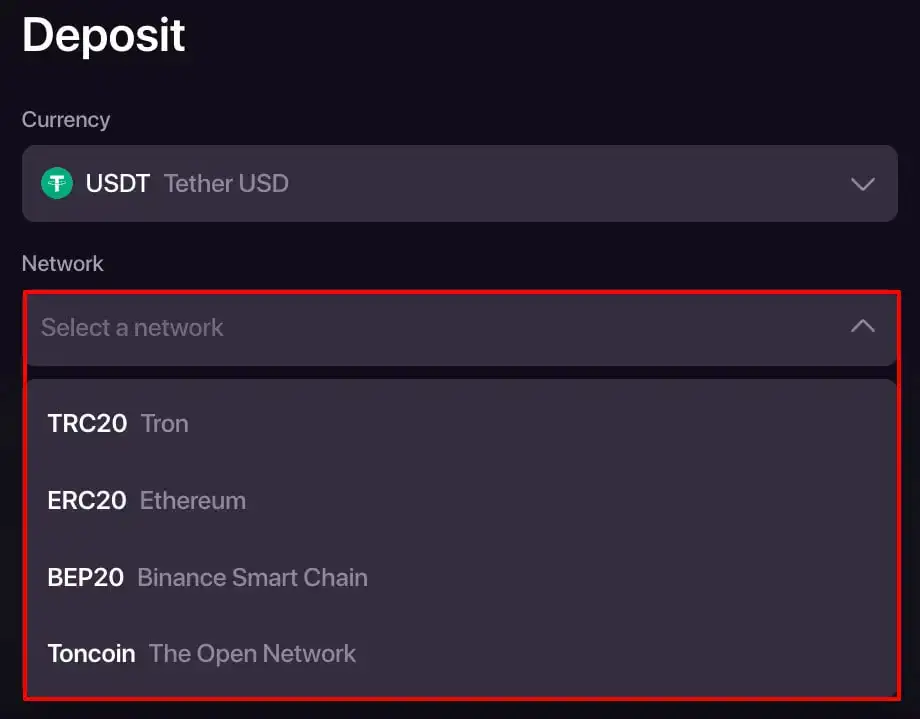
CHEXX supports 11 crypto assets across 9 networks: USDT, USDC, SOL, ETH, BNB, TRX, GRAM, POL, BTC, LTC and TRUMP. The network set is ERC-20, BEP-20, TRC-20, Polygon, TON, Bitcoin, Solana, Litecoin and TRUMP. Several assets, especially USDT and USDC, appear on more than one chain, so the coin ticker alone is not enough to define a deposit route. The full picture is in our CHEXX review for Kenya.
For a Kenya-based user, the practical choice is not simply “which coin?” but “which coin on which network?” CHEXX does not list direct KES or M-PESA funding in its listed payment rails. That makes correct blockchain selection the core payment-safety task before sending funds.
CHEXX supported coins and minimum deposits
| Network | Asset | Minimum deposit |
|---|---|---|
| ERC-20 | USDT | 5 USDT |
| ERC-20 | USDC | 5 USDC |
| ERC-20 | ETH | 0.003 ETH |
| BEP-20 | USDT | 5 USDT |
| BEP-20 | USDC | 5 USDC |
| BEP-20 | BNB | 0.009 BNB |
| TRC-20 | USDT | 5 USDT |
| TRC-20 | TRX | 15 TRX |
| Polygon | USDT | 5 USDT |
| Polygon | USDC | 5 USDC |
| Polygon | POL | 66 POL |
| TON | USDT | 5 USDT |
| TON | GRAM | 3.8 GRAM |
| Bitcoin | BTC | 0.00008 BTC |
| Solana | SOL | 0.07 SOL |
| Litecoin | LTC | 0.12 LTC |
| TRUMP | TRUMP | 3.4 TRUMP |
This matrix explains why CHEXX can advertise 11 supported assets while showing more than 11 deposit combinations. USDT is available across several chains, USDC across several chains, and some network-native assets have their own dedicated route.
11 assets, 9 networks: what the numbers mean
11 supported assets
USDT, USDC, SOL, ETH, BNB, TRX, GRAM, POL, BTC, LTC and TRUMP.
9 supported networks
ERC-20, BEP-20, TRC-20, Polygon, TON, Bitcoin, Solana, Litecoin and TRUMP.
Multiple-chain assets
USDT and USDC can appear on more than one supported blockchain, so the same ticker can lead to different deposit addresses or network rules.
Native-asset routes
BTC, SOL and LTC use their corresponding network routes in the CHEXX matrix.
CHEXX’s current public site continues to position cryptocurrency as a central platform feature. That matches the crypto payment model described in this guide. The detailed asset and minimum table above reflects CHEXX-specific payment options rather than a generic assumption about crypto casinos.
How to choose the right network
Start from the service that will send the crypto, not from a preference for a familiar chain name. The sending wallet or exchange must support the same asset-network pair that CHEXX displays for the deposit. If your exchange offers USDT on TRC-20 but you copy an ERC-20 address from CHEXX, you have created a mismatch even though both screens say USDT.
- Choose the asset inside CHEXX.
- Read the network options shown for that asset.
- Open the sending wallet or exchange and check which networks it supports for withdrawal.
- Select one network that appears on both sides.
- Copy the CHEXX deposit address for that exact chain.
- Check the minimum deposit and the sending service’s own minimum or fee.
- Confirm the network again before submitting the transfer.
Stablecoin routes: USDT and USDC
Stablecoins provide the broadest network choice in the CHEXX matrix. USDT is listed on ERC-20, BEP-20, TRC-20, Polygon and TON. USDC is listed on ERC-20, BEP-20 and Polygon. The minimum on each of those listed USDT and USDC routes is 5 units of the respective stablecoin.
That repeated 5-unit minimum does not make the networks operationally identical. Each chain has its own wallet support, external transaction fees and confirmation conditions. A Kenyan user who buys stablecoins through an external service should compare the full path: KES acquisition cost, exchange withdrawal fee, supported chain, CHEXX minimum and the likely withdrawal route later.
Choosing a chain solely because it has a low transfer cost can be a mistake if your preferred off-ramp does not support that network. Payment convenience should be judged end to end.
Native assets and their minimums
The CHEXX matrix also includes several non-stablecoin routes: 0.003 ETH on ERC-20, 0.009 BNB on BEP-20, 15 TRX on TRC-20, 66 POL on Polygon, 3.8 GRAM on TON, 0.00008 BTC on Bitcoin, 0.07 SOL on Solana, 0.12 LTC on Litecoin and 3.4 TRUMP on its listed route.
These values are denominated in the crypto asset itself. This guide does not convert them to KES because a fixed KES equivalent would move with market prices and would no longer represent the source value. If your budgeting starts in Kenyan shillings, calculate the current conversion separately at the time you plan the transaction.
Does CHEXX charge a deposit fee?
CHEXX states that it does not charge a fee for receiving deposits. That describes the platform-side receiving fee only. Your exchange, wallet or blockchain network can still charge for buying crypto or moving it to CHEXX.
This distinction matters because the cheapest CHEXX-side route is not necessarily the cheapest total route. A purchase spread, exchange withdrawal charge and blockchain fee can all sit outside the casino. For small deposits, those external costs can make up a noticeable percentage of the amount moved.
The broader CHEXX deposit Kenya explains this full Kenya funding path and why direct M-PESA is not described as a CHEXX payment method.
Network-selection safety notes
- Never infer a network from the ticker. USDT and USDC exist on multiple supported chains.
- Use the live deposit address. Do not reuse an old address from saved notes without checking the current wallet screen.
- Check destination support. A sending exchange can support an asset but not every network that CHEXX supports.
- Respect the minimum. Sending less than the stated minimum can create a crediting problem.
- Keep transaction records. Save the sending transaction ID so the transfer can be traced if necessary.
- Plan withdrawals too. A convenient deposit chain is more useful when your intended receiving wallet also supports it later.
CHEXX’s current withdrawal help specifically warns users to double-check the wallet address and network. That advice applies equally well before a deposit because the same blockchain-matching principle controls whether the transfer follows the intended route.
A final asset-and-network check before sending
The most important practical control is to match three items before a transfer: the asset selected in CHEXX, the blockchain network selected for that asset and the network used by the sending wallet or exchange. A coin name alone is not enough when the same asset can move on more than one supported chain. The minimum-deposit table should therefore be read together with the network label, not as a list of coin symbols in isolation.
If a supported asset has different listed minimums on different chains, use the minimum for the specific chain you are actually sending. CHEXX states that it charges no fee for receiving deposits, but that does not remove fees or limits imposed elsewhere in the route. Keeping those parts separate prevents an external exchange or network cost from being mistaken for a CHEXX deposit charge.

Kenya context: crypto is the bridge, not M-PESA
CHEXX’s funding model is crypto-only, so a Kenyan user who starts with KES must obtain a supported crypto asset outside the casino before depositing. That external conversion can involve M-PESA through a third-party service, but the third-party service is not part of CHEXX and should not be described as direct CHEXX M-PESA support.
This creates two separate decisions. First, decide how you will obtain the crypto. Second, decide which CHEXX-supported network you will use. Keeping those steps separate makes costs and responsibilities clearer and avoids confusing a local funding tool with the casino’s own payment rails.
Deposits and withdrawals should use one coherent plan
A crypto payment decision is incomplete if it only answers how to deposit. Before sending funds, check whether the same wallet or exchange can receive your intended withdrawal asset and network. CHEXX’s withdrawal flow also asks the user to choose a currency and network, so the exit route has the same technical dependency.
The CHEXX withdrawal covers cashout steps, network checks and why 24/7 withdrawal availability should not be read as a universal exact processing time. If you mainly use a phone, the CHEXX app explains the PWA and mobile workflow separately.
Which CHEXX crypto route is best?
There is no single best chain for every Kenya user because the deciding costs and compatibility often sit outside CHEXX. A sensible comparison uses four fields: whether you already hold the asset, whether your sending service supports the network, the external fee for moving it, and whether your intended withdrawal destination supports the same route.
If you are new to crypto, network familiarity can be more valuable than choosing the theoretically cheapest chain. A transfer that you can verify confidently is preferable to a route chosen only from a fee table. If you already use crypto regularly, CHEXX’s multi-network stablecoin support gives you more flexibility than a single-chain cashier. The way back out: withdrawals.
The safest route starts with the coin-network pair
CHEXX’s payment options support 11 crypto assets across 9 networks, with multiple routes for USDT and USDC plus native options such as BTC, ETH, SOL, LTC, BNB, TRX, POL and GRAM. The important operational detail is that the coin and network must be treated as one pair.
For Kenya users, crypto is the direct CHEXX payment rail, while KES or M-PESA would sit outside the casino in any conversion step. Check the live network, minimum and destination before sending. Return to the CHEXX Kenya review for the full product assessment.





 Turbo BlackjackFast-play
 Perfect Pairs BlackjackSide Bet
 Multihand BlackjackMultihand
 Ultimate Blackjack with RachaelLive-style
 Blackjack Lucky LadiesSide Bet
 Blackjack Surrender OriginsSurrender
 Vegas Downtown Blackjack GoldGold Series
 Premier Blackjack with Side BetsSide Bet
 Single Deck Blackjack GoldSingle Deck
 Atlantic City BlackjackClassic
 Vegas Strip BlackjackClassic
 Double Exposure BlackjackDouble Exposure
 American BlackjackClassic
 VIP American BlackjackVIP
 Blackjack 21 ClassicClassic
 American RouletteClassic
 Monopoly Roulette TycoonThemed
 Who Wants to Be a Millionaire RouletteThemed
 Multifire RouletteMultiplier
 Mega Fire Blaze RouletteMultiplier
 Auto RouletteSwitch Studios
 Roca Riches RouletteThemed
 Gold RouletteGold Series
 Mini Roulette 3DMini
 European RouletteClassic
 Double Ball American RouletteDouble Ball
 French RouletteNetEnt
 Lucky RouletteClassic
 Immortal Romance RouletteThemed
Published by the Chexx Casino team.